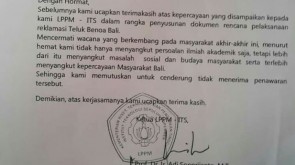
Professional surfers have expressed serious concerns over the planned reclamation and development at Tanjung Benoa, or Benoa Bay, saying it could diminish the island’s surf.
“Any massive construction and huge development projects in Tanjung Benoa will likely have a great impact on the course and intensity of the waves and sea currents. The Benoa Bay reclamation and development will definitely turn Bali’s beaches into a hell for most local and international surfers,” Piping Irawan, a professional surfer, shared with Bali Daily on Sunday.
Piping said that Bali was viewed as having the potential to be a top global surfing destination because the island’s beaches had strong and high waves.
Bali has become a surfing mecca for international professional surfers. Many tourists also come to the island to surf.
“The reclamation will affect waves and make surfers leave Bali. Surfing is one of the island’s main tourist attractions and is very popular among upscale tourists,” he declared.
Citing an example, Piping said that the reclamation of Serangan Island had killed the surf waves around area. The Serangan reclamation also changed the currents, causing acute erosion on the beaches along Sanur up to Karangasem.
A revetment, a sloping structure made of stone and concrete designed to maintain the beach’s sandy shoreline and prevent further erosion, unfortunately, could not resolve the problem.
Meanwhile, concrete structures and tourism development projects had ruined many previously popular surfing points, including at Matahari Terbit Beach, and many other points in Gianyar.
Piping added that the surf in front of Discovery Shopping Mall in Kuta had once been a favored surfing point as it had stunning waves that often soared to twice the height of an adult man.
However, the waves now only reach knee height as the presence of the wave breakers in front of the development have literally killed the waves. “The wave breakers could significantly change the waves and current. I can’t imagine what will happen if the huge reclamation in Benoa Bay takes place. The impact would significantly damage the island’s environment, including several surfing points,” Piping said.
Piping questioned the unfinished feasibility study conducted by Udayana University that states the reclamation could repair the environmental quality in the surrounding areas. “It is a strange study. Has Udayana University conducted the study objectively? I am worried that the study was conducted under the investor’s orders, and the conclusion was made based on that order,” he added.
In December 2012, Bali Governor Made Mangku Pastika granted PT Tirta Wahana Bali International permission to develop an integrated tourist attraction by reclaiming land around Benoa Bay. The investor was granted the right to manage 838 hectares with a 30-year concession and the possibility of a 20-year extension.
Tirta Wahana Bali International intends to develop luxurious facilities, including a Disneyland-like theme park, apartments, hotels, villas, an international hospital and entertainment centers.
Pastika’s decision stirred controversy among activists, scholars and communities on the island, who told the governor to revoke the permit. However, Pastika rejected revoking the letter, saying that it was based on the recommendation of the Bali Legislative Council and a feasibility study conducted by Udayana University.
On Saturday, Pastika reaffirmed his stance. “I think it just about perception. Many people are yet to understand the reclamation plan. With positive thinking, I think we can conduct further studies to identify the possible negative impact and benefits,” he told reporters after a youth competition on the Bali Mandara program at the governor’s official residence in Denpasar.
“I think there is no problem with reclamation. Many countries all over the world reclaim land as sea water levels rise. All countries are doing it, so we have to do it. Reclamation is one alternative solution for a small island to expand our land,” the governor insisted, turning a deaf ear to the many protests.
source: http://www.thejakartapost.com/bali-daily/2013-07-22/surfers-fear-benoa-development.html
Professional surfers have expressed serious concerns over the planned reclamation and development at Tanjung Benoa, or Benoa Bay, saying it could diminish the island’s surf.
“Any massive construction and huge development projects in Tanjung Benoa will likely have a great impact on the course and intensity of the waves and sea currents. The Benoa Bay reclamation and development will definitely turn Bali’s beaches into a hell for most local and international surfers,” Piping Irawan, a professional surfer, shared with Bali Daily on Sunday.
Piping said that Bali was viewed as having the potential to be a top global surfing destination because the island’s beaches had strong and high waves.
Bali has become a surfing mecca for international professional surfers. Many tourists also come to the island to surf.
“The reclamation will affect waves and make surfers leave Bali. Surfing is one of the island’s main tourist attractions and is very popular among upscale tourists,” he declared.
Citing an example, Piping said that the reclamation of Serangan Island had killed the surf waves around area. The Serangan reclamation also changed the currents, causing acute erosion on the beaches along Sanur up to Karangasem.
A revetment, a sloping structure made of stone and concrete designed to maintain the beach’s sandy shoreline and prevent further erosion, unfortunately, could not resolve the problem.
Meanwhile, concrete structures and tourism development projects had ruined many previously popular surfing points, including at Matahari Terbit Beach, and many other points in Gianyar.
Piping added that the surf in front of Discovery Shopping Mall in Kuta had once been a favored surfing point as it had stunning waves that often soared to twice the height of an adult man.
However, the waves now only reach knee height as the presence of the wave breakers in front of the development have literally killed the waves. “The wave breakers could significantly change the waves and current. I can’t imagine what will happen if the huge reclamation in Benoa Bay takes place. The impact would significantly damage the island’s environment, including several surfing points,” Piping said.
Piping questioned the unfinished feasibility study conducted by Udayana University that states the reclamation could repair the environmental quality in the surrounding areas. “It is a strange study. Has Udayana University conducted the study objectively? I am worried that the study was conducted under the investor’s orders, and the conclusion was made based on that order,” he added.
In December 2012, Bali Governor Made Mangku Pastika granted PT Tirta Wahana Bali International permission to develop an integrated tourist attraction by reclaiming land around Benoa Bay. The investor was granted the right to manage 838 hectares with a 30-year concession and the possibility of a 20-year extension.
Tirta Wahana Bali International intends to develop luxurious facilities, including a Disneyland-like theme park, apartments, hotels, villas, an international hospital and entertainment centers.
Pastika’s decision stirred controversy among activists, scholars and communities on the island, who told the governor to revoke the permit. However, Pastika rejected revoking the letter, saying that it was based on the recommendation of the Bali Legislative Council and a feasibility study conducted by Udayana University.
On Saturday, Pastika reaffirmed his stance. “I think it just about perception. Many people are yet to understand the reclamation plan. With positive thinking, I think we can conduct further studies to identify the possible negative impact and benefits,” he told reporters after a youth competition on the Bali Mandara program at the governor’s official residence in Denpasar.
“I think there is no problem with reclamation. Many countries all over the world reclaim land as sea water levels rise. All countries are doing it, so we have to do it. Reclamation is one alternative solution for a small island to expand our land,” the governor insisted, turning a deaf ear to the many protests.
source: http://www.thejakartapost.com/bali-daily/2013-07-22/surfers-fear-benoa-development.html